


Hey y’all!
Welcome to the *new* Ordinary Genius.
New sending schedule:
Every Tuesday = playbook. Every Friday = real case study.
New layout:
Here’s the thing you want
Here’s how to do it
Here’s why it works
Here’s what to avoid
You’ll know its working when…
Now go!
Have any feedback? Reply directly or DM me anywhere @heyalexfriedman.
Today we’re covering how to ask better questions. Not networking tips, or sales jargon. The real stuff like how to have conversations that actually matter.
Writing this from Austin, Texas. Let’s go!!
Here’s the thing you want:
You want to be the person people want to talk to.
Not because you’re the loudest or the most interesting… but because when you ask a question it’s obvious that you MEAN it. The conversation gets better, people open up, small talk disappears, and everyone leaves feeling like you actually got them.
Good questions do that. Most people ask terrible questions lol
They ask what they think they’re supposed to ask: questions designed to make themselves look smart, leading questions because they already decided what the other person should do, etc.
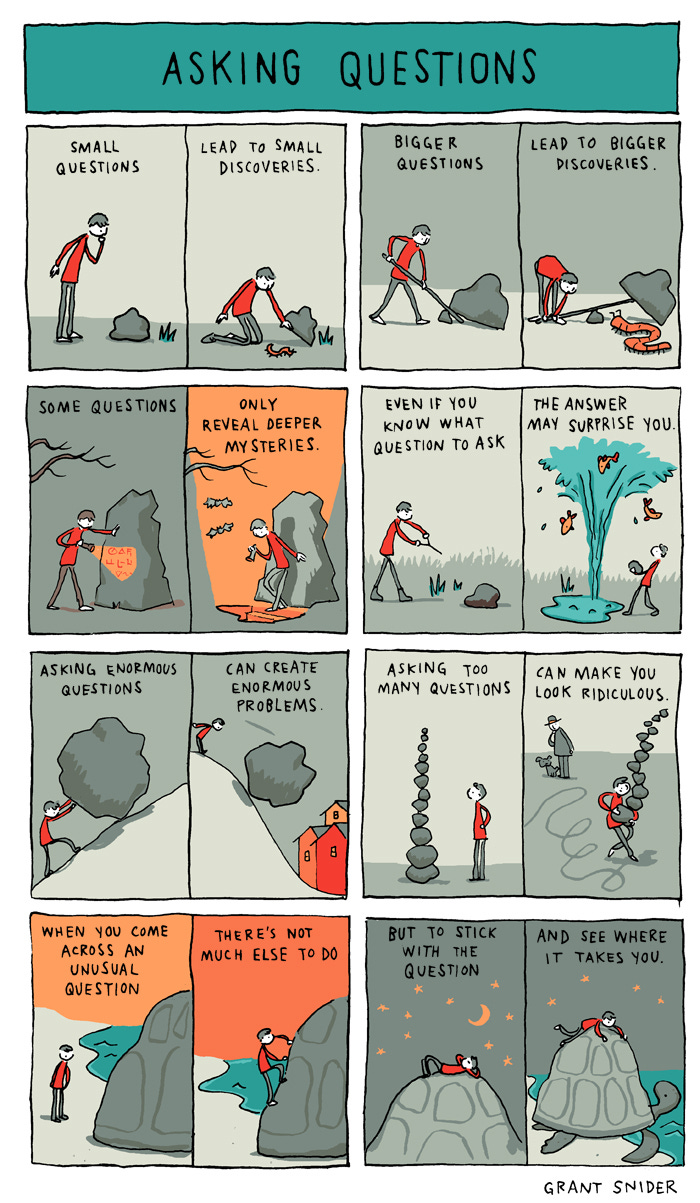
You don’t have to be that person!
Here's how to do it:
Step 1: Stop trying to sound smart
The best questions aren’t clever. They’re simple.
When I worked at Techstars, my coworker Trevor was the master at this. Founders would come to him stuck on some decision, and instead of telling them what to do, he’d just… ask questions. Simple ones likeeeeee……..
“What are you trying to solve here?”
“What happens if you don’t do this?”
“What’s the version of this that feels true to you?”
He wasn’t performing. He was genuinely curious. And somehow, founders would leave his office having solved their own problem.
Your job isn’t to have the answer. It’s to help them find theirs.
Step 2: Don’t ask leading questions
Leading question: “Don’t you think you should focus on growth right now?”
(Translation: I’ve already decided what you should do, and I’m trying to get you to agree.)
Clarifying question: “What’s making you feel like you need to choose between growth and product right now?”
(Translation: I’m genuinely trying to understand your situation.)
The difference is massive. One makes people defensive. The other makes them think.
The pattern: Repeat back what they said in a different way. That’s it. It sounds simple, but most people never do it because they’re too busy thinking about what they want to say next. Pushing someone deeper on their own question allows them to process their thoughts further. Usually they will find the conclusion on their own (and still give you the credit for finding it)
Step 3: Use the “What” and “How” framework
These are your power words:
“What are you optimizing for?”
“What would this look like if it were easy?”
“How are you thinking about this?”
“What’s the thing you’re not saying?”
Notice: no “Why” questions. “Why” makes people defensive. “What” and “How” make people reflective.
Step 4: Go one level deeper
Most people stop at the surface answer. You want the second or third layer.
Surface: “What are you working on?”
One level deeper: “What part of that are you most excited about?”
Two levels deeper: “What would success actually look like for you?”
The first question is small talk. The third question is a real conversation.
Step 5: Make it context-appropriate
On a date:
Bad: “What do you do for work?”
Better: “What’s keeping you busy these days?”
Even better: “What’s something you can’t stop thinking about lately?”
In a meeting:
Bad: “Don’t you think we should do X?”
Better: “What are the trade-offs you’re seeing?”
Even better: “What outcome are we optimizing for here?”
As a mentor/advisor:
Bad: “Here’s what you should do…”
Better: “What options are you considering?”
Even better: “What would you do if you weren’t afraid?”
Step 6: Listen for the real answer
The first answer is rarely the real answer.
Someone says, “I’m fine.”
You say, “Lol what does FINE mean?”
They pause, loosen up, then get to the actual answer.
Your job is to create space for the real answer to come out. That means being comfortable with silence. That means not jumping in with your own story. That means actually listening instead of waiting for your turn to talk.
Step 7: Process out loud when you’re not sure what to ask
It’s okay to say:
“I’m trying to understand what you mean by that… can you say more?”
“I’m processing this… help me make sure I’m getting it right.”
“I don’t know what to ask yet, but this is interesting. Keep going.”
You don’t have to have the perfect question ready. Sometimes the best move is admitting you need more information or time to ask a better follow up.
Here’s why it works:
Psychology: People already know their answers. They just need someone to help them surface it. When you ask clarifying questions instead of giving advice, you’re treating them like they’re capable of figuring it out.
Culture: We’re in a world where everyone’s talking, nobody’s listening. When you actually ask thoughtful questions, you stand out. You become the person people want to talk to… not because you’re impressive, but because you make them feel heard.
Strategy: Good questions build trust faster than anything else. They show you’re paying attention. They show you care about the other person’s perspective, not just your own. In business, in relationships, in life… that matters more than you think.
Here’s what to avoid:
Don’t ask questions to feed your own ego.
If you’re asking a question to show off how much you know, stop. It’s transparent, and it makes people not want to talk to you.
Don’t ask “gotcha” questions.
Questions designed to trap someone or make them feel dumb aren’t questions. If your goal is to prove someone wrong, you’ve already lost the conversation.
Don’t ask when you’ve already decided the answer.
Leading questions are manipulative. If you’ve already decided what someone should do, either say it directly or don’t say anything. Don’t pretend to be curious when you’re not.
Don’t over-complicate it.
Simple questions are better than clever ones. “What do you mean by that?” Or “Can you tell me more about that?” is often the best question you can ask.
Don’t fill the silence.
After you ask a good question, shut up. Let them think. Let them sit with it. The silence is where the real answer lives.
You’ll know it’s working when:
People start opening up to you more
Conversations feel less like interviews and more like actual exchanges
You walk away understanding what someone actually meant, not just what they said
People tell you “I’ve never thought about it that way before”
You stop feeling like you have to have all the answers
Silence doesn’t feel awkward anymore, it feels productive
Now go!
Today: Pick one conversation…
a meeting, a coffee, a phone call and commit to asking one clarifying question instead of giving advice.
Try: “What are you optimizing for?” or “What would this look like if it were easy?”
Then do the hardest thing: shut up and listen.
Start here if you only have 10 minutes:
Replace “Why did you do that?” with “How are you thinking about that?” in your next conversation. Notice what changes.
Trying out a new format to write the best newsletter ever written,
Your friend Alex
This is so insightful. I go too hard on myself and always feel like I’m doing something wrong in my conversations but actually I’m on a pretty good track. Wow, thank you!