


I know someone who runs a business, has kids, volunteers, plans parties and family dinners, always seems to be there for her friends, etc., and she consistently gets things done in a way that makes me feel slightly embarrassed about my own excuses. So I finally just asked her “how do you stay motivated? Because from the outside, you’re always moving!”
She laughed when I asked. A real laugh, like the question itself was funny.
“I’m not motivated,” she said. “I just have a plan.”

That felt like a cop-out, like something you say when you don’t want to explain the real answer. But the more she talked, the more I realized she meant it literally. Motivation, for her, isn’t the starting point. It’s what shows up after she’s already begun, and she figured out a long time ago that waiting for it to arrive before she started was a losing battle.
She told me about a goal she’d had for a while, something she really wanted and thought about constantly. And then, just didn’t do it. Months went by and the longer she waited, the further back the starting line got, until she finally decided that waiting to do it “right” was costing her more than starting and doing it “badly”. So she started. Ten minutes. That was it, just ten minutes of actually doing the thing. She told me she scoffed at herself, “how is ten minutes going to do anything?!”
I asked her, “okay, so did you think the same thing after just 10 minutes of work?”
She replied, “No, and I was shocked. At the end of those ten minutes I felt something I hadn’t felt in a while. Proud. Not of what I’d made, but that I’d finally moved. And that feeling made me want to come back the next day.”
“All big things come from small beginnings.”
— Richard Branson
And that’s the ticket. Progress doesn’t have to be a leap. It can be embarrassingly small, but it counts. Small progress creates a feeling that makes you want to come back, and coming back is what compounds. Ten minutes became fifteen, fifteen became thirty, she started gaining momentum, momentum meant she wanted to spend more time on it, more time meant more visible progress, and eventually she looked up and she was there.
But she made a mistake.
She didn’t have a plan for after. She hit the goal, felt great, and but didn’t think about what it would take to keep it. Things started slipping. Slowly at first, then faster, until enough time had passed that she admitted she’d lost most of what she’d built. “The come down after accomplishing something,” she told me, “is one of the sneakiest motivation killers there is.”
“Success is never final; failure is never fatal.“
— Winston Churchill
If you don’t know what you’re going to do after you cross the finish line, hitting the goal can actually bring you to a screeching halt. So now when she sets a goal, she also thinks about what comes next. Sometimes that’s a new goal, sometimes it’s a maintenance goal, but either way, it’s a clear picture of what holding the ground looks like, and what it would cost her if she didn’t. She’s still working on getting back to where she was, the difference is now she knows what she’s doing when she gets there.
When I asked her what the actual system looks like day to day, she was pretty specific about it. She has a big picture goal in mind, including when she wants it done, and writes it down, breaking out milestones. She spends time at the beginning of each month and sets up her schedule to accomplish one of those milestones, or even part of one. And she’s ruthlessly honest about her energy. She knows there will be days when she’s just too tired or there’s too much going on with the kids or family is coming in town, etc…, so she literally schedules “no work” days. And if there needs to be a lot of those, she readjusts her goal.

This is true in reverse as well. It helps her set boundaries with life outside work. If she needs to get something done, she doesn’t have to think about whether she can bake cookies for the PTA. She just looks at the calendar and says no. No thinking about. No shame. No overcommitting. She’s learned from experience that putting something on the calendar she won’t do just means she’ll feel awful about it later. And feeling awful is the opposite of motivating.
“When I don’t do those things,” she said, “everything falls apart the same way every. time. Deadlines sneak up, I’m disorganized, the work gets messy, the STRESS piles up, and then it’s harder to get back on track, which makes me feel worse, which makes me want to not do it at all.” She called it the shame loop, and she said it will eat you alive.
I learned a lot talking to her, but the biggest impact was realizing the being motivated isn’t a personality trait. She said she’s watched people with almost no natural drive build amazing things. And she’s watched people who seemed endlessly fired up flame out because the fire was the whole system, and fire runs out.
“Motivation isn’t real,” she said. “Progress is.”
Here’s the thing you want:
You want to stop feeling like the people around you have something you don’t, like there’s some internal engine running in other founders and builders and that yours is missing or sprung a leak.
You want to get out of the shame loop, the one where you don’t start because you don’t feel motivated, feel bad about not starting, which makes it harder to start, and by the time you go to bed you’ve convinced yourself you’re falling behind and maybe you’re not cut out for this.
You’re not broken. You’re not behind. And the motivation you think you’re missing probably isn’t what’s actually standing between you and moving forward.
Here’s how to do it:
Stop waiting for the feeling. Build the plan instead.
The plan removes confusion that kills momentum before it starts. Big picture first: what do you actually want to accomplish and by when. Then break it into monthly goals. Weekly and daily if you need to. The key word is honest. Not aspirational, not what you’d do with unlimited time and perfect energy. What you can actually do given your schedule and your life as it is right now.
Then protect the time. Put it on the calendar before the week gets away from you. And on the days where you know you won’t have the bandwidth, don’t schedule work. A plan you’ll actually follow beats a perfect plan you’ll ignore every single time.
The cool thing is that the plan can always change. Life transition, change your goals. Realize that you weren’t right about how long one part will take, adjust the timeline, if something comes up and you can’t accomplish what you wanted that day, don’t be too hard on yourself. Life is going to happen, it’s OK to let it. Adjusting your plan doesn’t equal failure. It’s just part of the plan.
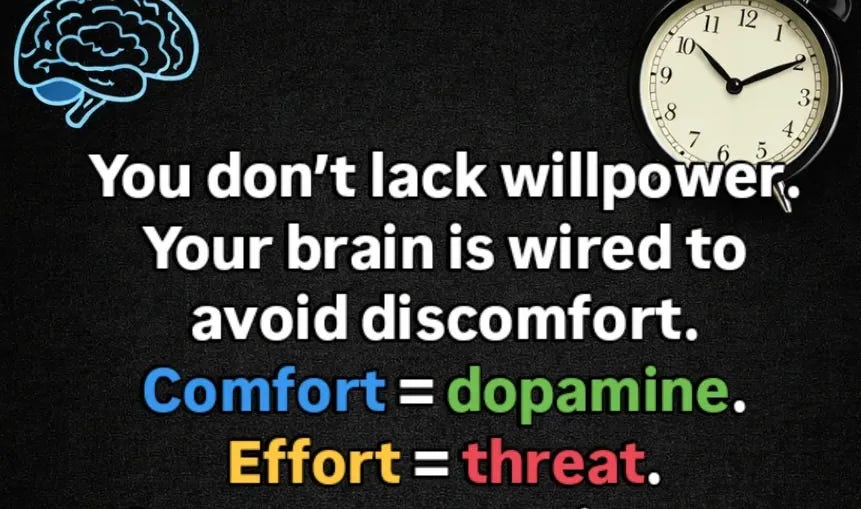
First step, start with something small. Small enough that you almost don’t even want to tell someone. One email. One paragraph. One corner of the desk. Our brains are naturally wired to avoid doing something hard, and if it feels big or heavy or unclear, your brain will win. But if the thing is small enough, there’s no friction, you’ll do it, and doing it is what starts the engine. It also helps to keep the end goal visible. Don’t write a plan and then stick it in a drawer. Tape it to your monitor, put it on your fridge, your bathroom mirror. Remind yourself as often as possible where you’re headed. A maybe even put affirmations or motivational sticky notes somewhere. It may be cheesy, but it works when you’re feeling like you’re in the trenches
When you hit the goal, don’t stop. Think about what comes next before you get there. Set the maintenance goal. Write down what it would cost you if you didn’t. That part matters more than most people think.
Here’s why it works:
When you stop waiting for motivation and start treating progress as the thing that creates it, the shame loop loses its grip. You don’t need to feel a certain way to take the next step, you just need to know what it is and and make it small enough that its not intimidating. The plan removes the confusion, the small step removes the resistance, and the progress that follows is what brings the feeling back. It’s more honest too. You’re not pretending you’ll wake up fired up every day. You’re building something that works on the days you don’t.
Now go:
This week, try this: Block 30 minutes, not to do work, but to map it. Write down the one thing you’re trying to accomplish in the next 30 days, then work backwards. What needs to happen this week for that to be possible? What needs to happen today? Be honest about your schedule and don’t put things on days where you know you won’t have the bandwidth.
Start here if you only have 10 minutes: Open your calendar and find three blocks this week where you can realistically do focused work. Block them now, before you do anything else. Don’t figure out what you’ll work on yet, just protect the time. That’s enough for today.
P.S. I know I want to consistently send out a newsletter. I know I need to write them. Sometimes, I just don’t have the bandwidth and feel bad about not getting to it sooner. Apparently I needed to take my own advice. But that’s kind of the whole point, isn’t it? Even the people writing about motivation are in the trenches with you. Some days I genuinely cannot find the gear, and the only thing that gets me going is remembering that doing something small today is always better than waiting until I feel ready. I’m still learning that. Probably always will be. But every time I take the small step, I remember why it works, and that’s usually enough to take the next one.
If this resonates, hit reply and tell me where you’re stuck in this transition. I read every response.
Writing from Austin, still building the plan,
Alex
We also work with founders and teams on ghostwriting and go-to-market support—helping turn ideas into clear content for positioning, launches, and distribution.
If that’s something you’re thinking about, happy to chat. Feel free to put some time on my calendar here.